Project Overview
This project demonstrates an automotive cybersecurity implementation using a Raspberry Pi 5. It simulates a realistic vehicle network attack scenario, showing how a hacker can remotely control a vehicle's CAN Bus via a compromised connected device (e.g., a Wi-Fi Gateway). Furthermore, it implements a robust defense mechanism using HMAC Signatures and Rolling Counters..
Demo: Attack and Defense
CAN Bus Security Simulation: Attack vs. Defense
This project simulates two distinct scenarios, ranging from a completely vulnerable system to a secured architecture with a Security Gateway (Guardian).
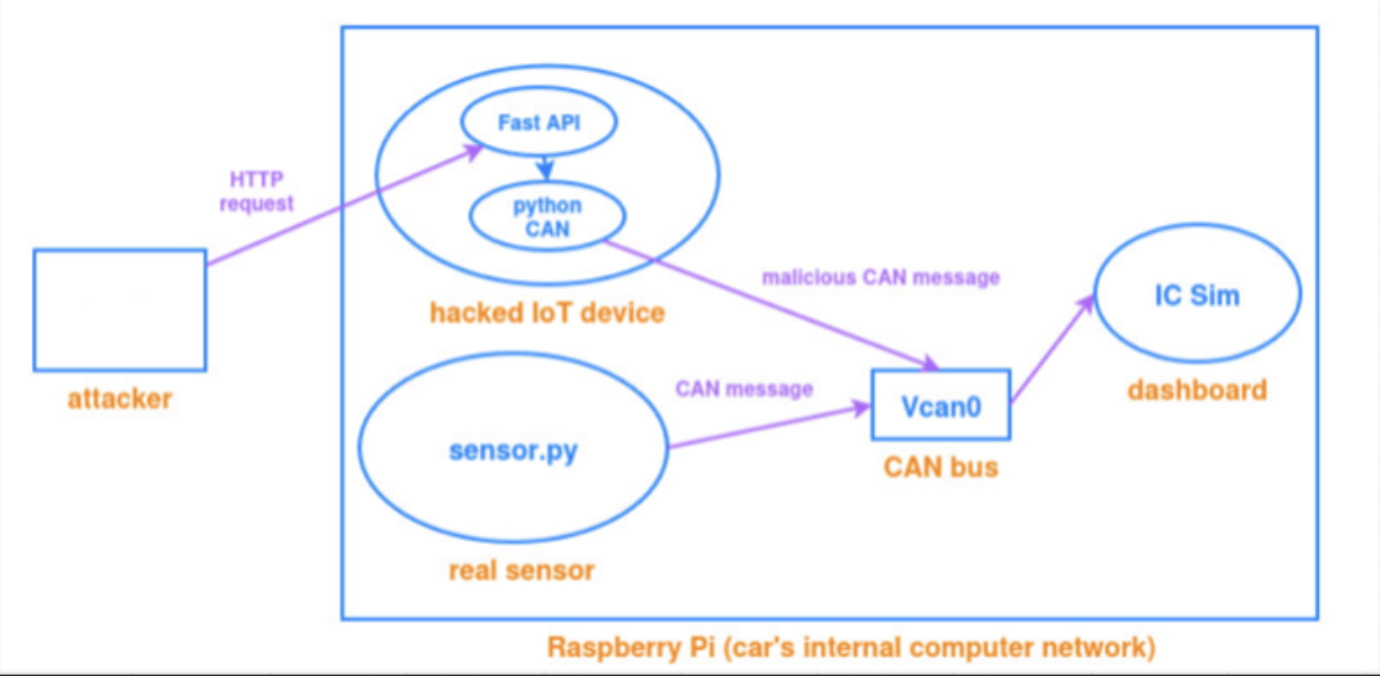
Scenario 1: The Attack (Unprotected)
In this scenario, the internal vehicle network (vcan0) lacks any authentication mechanism.
A hacker utilizes a compromised Web Gateway (main.py) to inject malicious CAN frames into the bus
via HTTP requests, effectively spoofing the speedometer on the dashboard (IC Sim).
Scenario 2: The Defense (Secured)
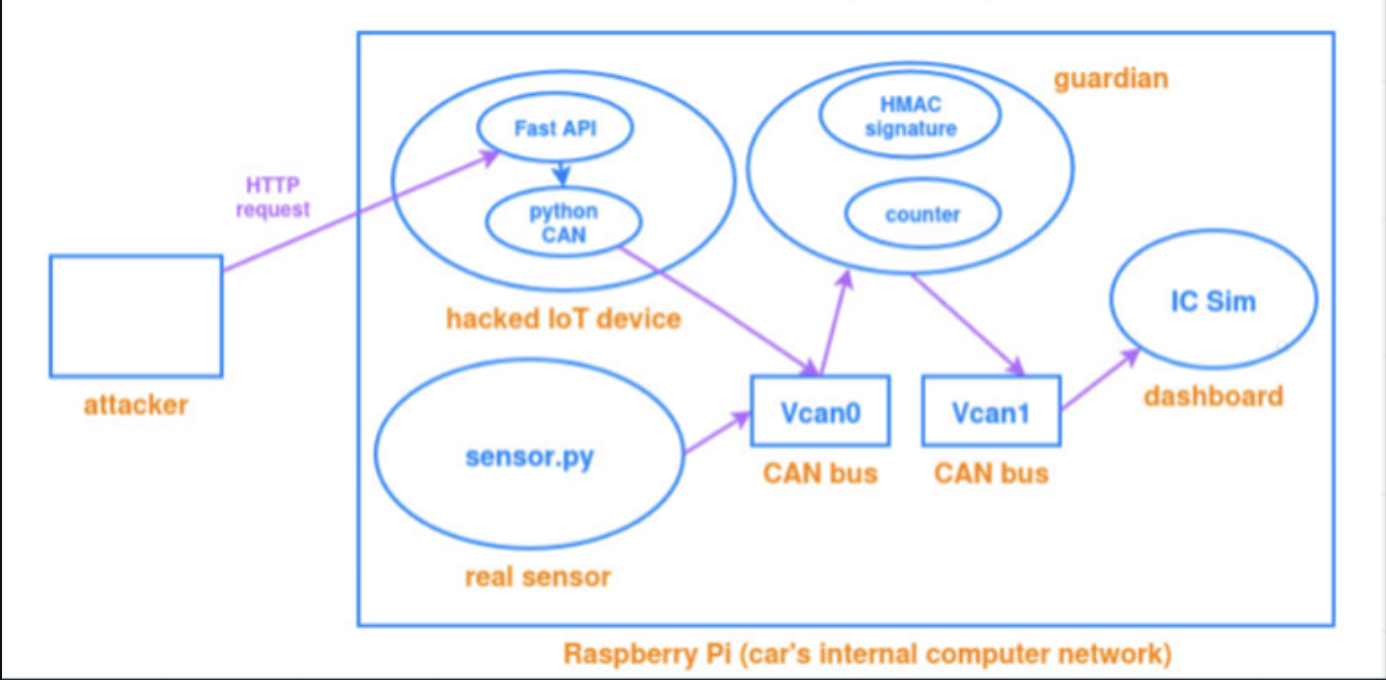
In this scenario, we introduce a Guardian (Security Gateway) and a Secure Sensor.
-
Network Segmentation:
The network is split into an "Untrusted Zone" (
vcan0) and a "Trusted Zone" (vcan1). - Authentication: The sensor signs data using HMAC-SHA256.
- Anti-Replay: A Rolling Counter is implemented to prevent replay attacks.
The Guardian monitors vcan0, filters out forged packets from the hacker,
and forwards only verified data to the dashboard located on vcan1.